With almost everybody using AI for content creation, you cannot just rely on your writing skills alone. They will make you slower than others.
According to SurveyMonkey, almost 88% of marketers are using AI for at least one thing in their jobs.
But if you rely on AI for content writing, the human touch will be missing, which Google demands in your words. Google clearly states that it requires EEAT in your content for SERP rankings.
Search has changed, and not in a small way.
For years, the model was predictable. You created content, ranked on Google, and got traffic. That’s how SEO worked.
But that model is no longer reliable.
Today, a large percentage of users search on Google and never click anything. They get their answer directly on the results page and move on.
In fact, studies show that around 60% of Google searches now end without a click.
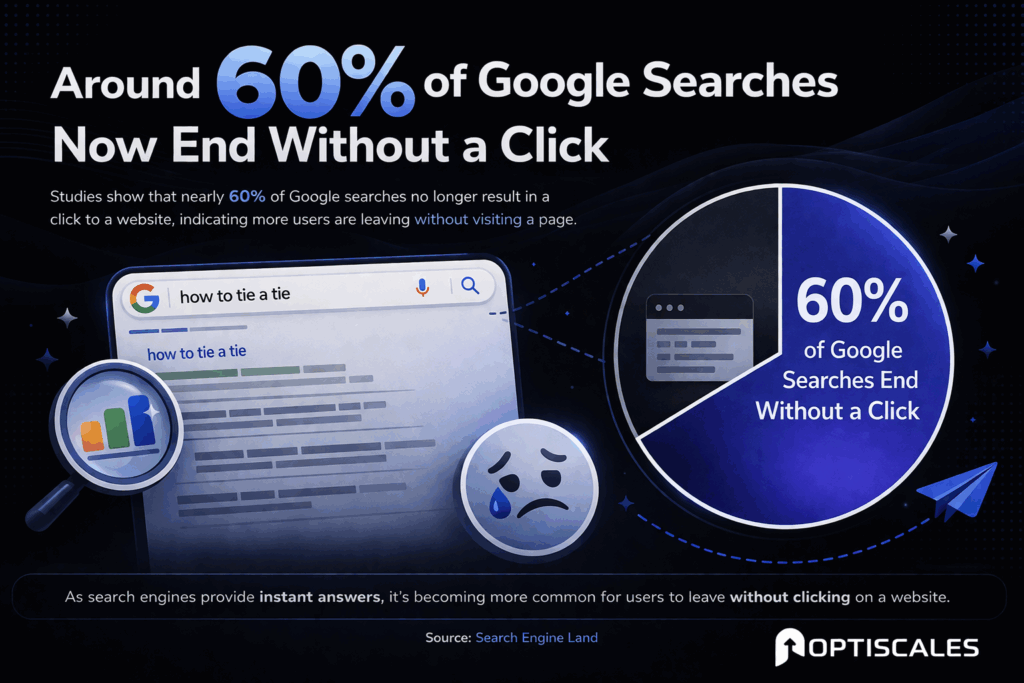
This is known as zero-click search, and it’s one of the biggest reasons websites are losing traffic.
Even when rankings look fine.
What is zero-click search?
Let’s simplify it.
Zero-click search means a user finds the answer on Google without visiting any website.
Instead of clicking a result, they read what Google shows and leave.
These answers appear as:
- Featured snippets
- Google Overviews (AI-generated summaries)
- Knowledge panels
- Instant answers
For example, if someone searches “what is zero click search”, Google may show a direct definition at the top. The user reads it and moves on.
No click happens.
Why Google Doesn’t Send Traffic Anymore
This shift didn’t happen randomly. It’s the result of how Google has evolved.
Google is no longer just organizing information; it’s trying to deliver answers instantly.
1. Google is keeping users on its platform
Google benefits when users stay.
So instead of sending users away, it increasingly answers queries directly on the search page.
This is why the search results page is changing. It’s no longer just a list of links; it’s becoming the final destination.
2. AI has changed how search works
AI has accelerated this shift dramatically.
With Google Overviews and LLM-powered systems, Google can now:
- Summarize multiple sources
- Generate clear answers instantly
- Handle more complex queries
This is what defines modern AI-powered search.
And when users get a complete answer right away, they simply don’t need to click.
3. AI overviews are already reducing clicks
Early data shows the impact clearly.
When AI-generated answers appear at the top of search results, Ahrefs says that click-through rates can drop by 34.5% or more.
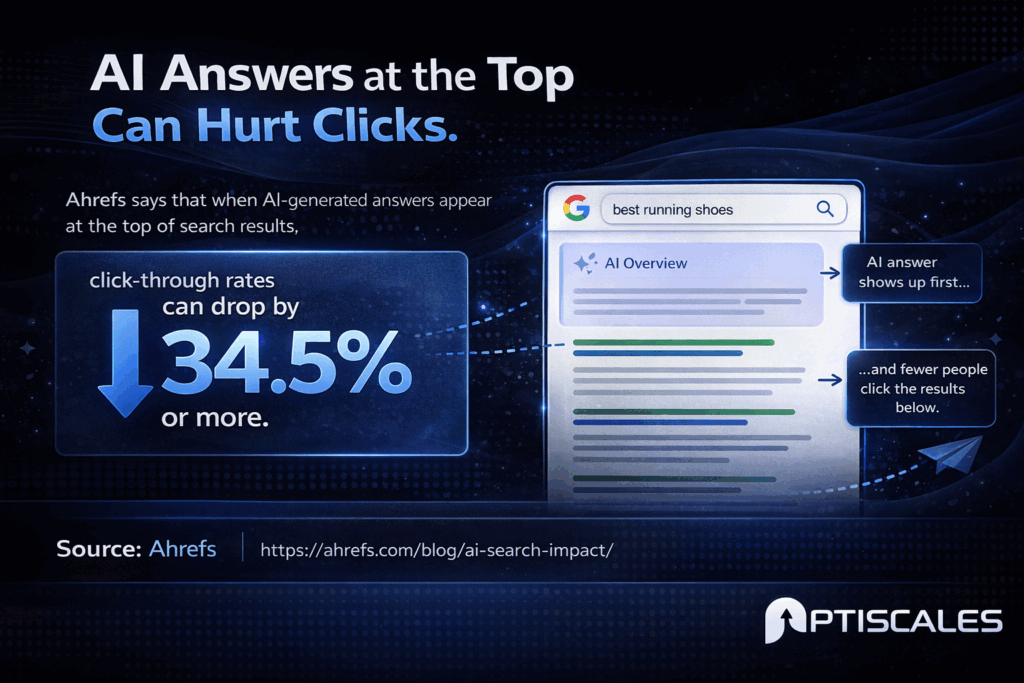
That means even top-ranking pages are getting fewer visits.
4. Most searches are simple
A large portion of searches are informational:
- “What is SEO?”
- “Why is my traffic dropping?”
- “How does Google ranking work?”
These are easy to answer directly.
So Google does exactly that.
The data behind zero-click search
The trend is growing fast.
- Around 65% of searches end without a click
- On mobile, the number is even higher
- Organic clicks are decreasing while impressions increase
Another key insight:
👉 Only about 1 in 3 searches leads to a click on an organic result
This explains why many websites are seeing:
- More impressions
- Less traffic
That’s one of the strongest zero-click search signals.
How zero-click search affects your website
This is where most people get confused.
Because traditional SEO metrics don’t tell the full story anymore.
1. Rankings don’t guarantee traffic
You can rank on page one, even at the top, and still lose clicks.
If Google provides the answer directly, users often don’t scroll further.
2. Visibility has replaced clicks
Earlier, success meant traffic.
Now, it increasingly means visibility.
Your content might appear in zero-click search results, get read, and influence users.
Without generating a visit.
3. Google overviews are changing behavior
With the rollout of Google Overviews, users now see complete answers summarizing multiple sources.
This reduces the need to visit individual pages.
It’s one of the biggest drivers behind current zero-click search trends.
The shift from SEO to AEO
This is the real change.
Traditional SEO is still important, but it’s no longer enough.
You’re no longer just competing to rank.
You’re competing to be selected as the answer.
That’s where Answer Engine Optimization (AEO) comes in.
If we simplify it:
- SEO helps you appear in search results
- AEO helps you appear in answers
This is the core difference in SEO vs AEO.
How zero-click search works
Google looks for content it can easily extract and present.
It prefers content that is:
- Clear
- Well-structured
- Direct
- Easy to summarize
These are strong zero-click search signals.
If your content is hard to understand or poorly structured, it’s less likely to be used.
Zero-click search optimization: What you should do
You can’t stop this shift.
But you can adapt to it.
Answer Questions Clearly: Start with the answer. Don’t make users or Google search for it.
Keep Your Language Simple: Content that is easy to understand performs better in AI-driven systems and LLMs.
Structure Your Content: Use headings, lists, and short paragraphs.
This makes your content easier to extract into zero-click search results.
Focus on Question-Based Queries: Queries like “what,” “how,” and “why” are more likely to trigger zero-click answers.
Build Topical Authority: Create related content around your topic:
- What is zero-click search
- Zero-click search optimization
- How to rank in AI-powered search
- SEO vs AEO
This helps Google trust your content more.
Can You Still Get Traffic?
Yes, but the strategy is different.
Focus on Depth: Simple queries lead to zero clicks. Complex topics still drive traffic. Go deeper and provide more value.
Use Visibility as Leverage: Even without clicks, appearing in answers builds authority and recognition.
Combine SEO and AEO: You don’t replace SEO, you expand it.
- SEO helps you rank
- AEO helps you get selected
Together, they help you get discovered in AI-powered search.
Final Thoughts
Zero-click search is not a temporary trend. It’s a structural shift.
Google is moving from showing links to giving answers.
And with AI accelerating this change, the gap between rankings and traffic will continue to grow.
If you rely only on traditional SEO, you’ll likely struggle.
But if you adapt, by focusing on clarity, structure, and answer-driven content, you can still stay visible.
Because today, success in search is no longer just about ranking.
It’s about being the answer.